Condo vs. Detached Home Price Comparison in North Oakville
Compare condo and detached home prices in North Oakville, plus closing costs, monthly costs, and which property fits your budget and lifestyle.
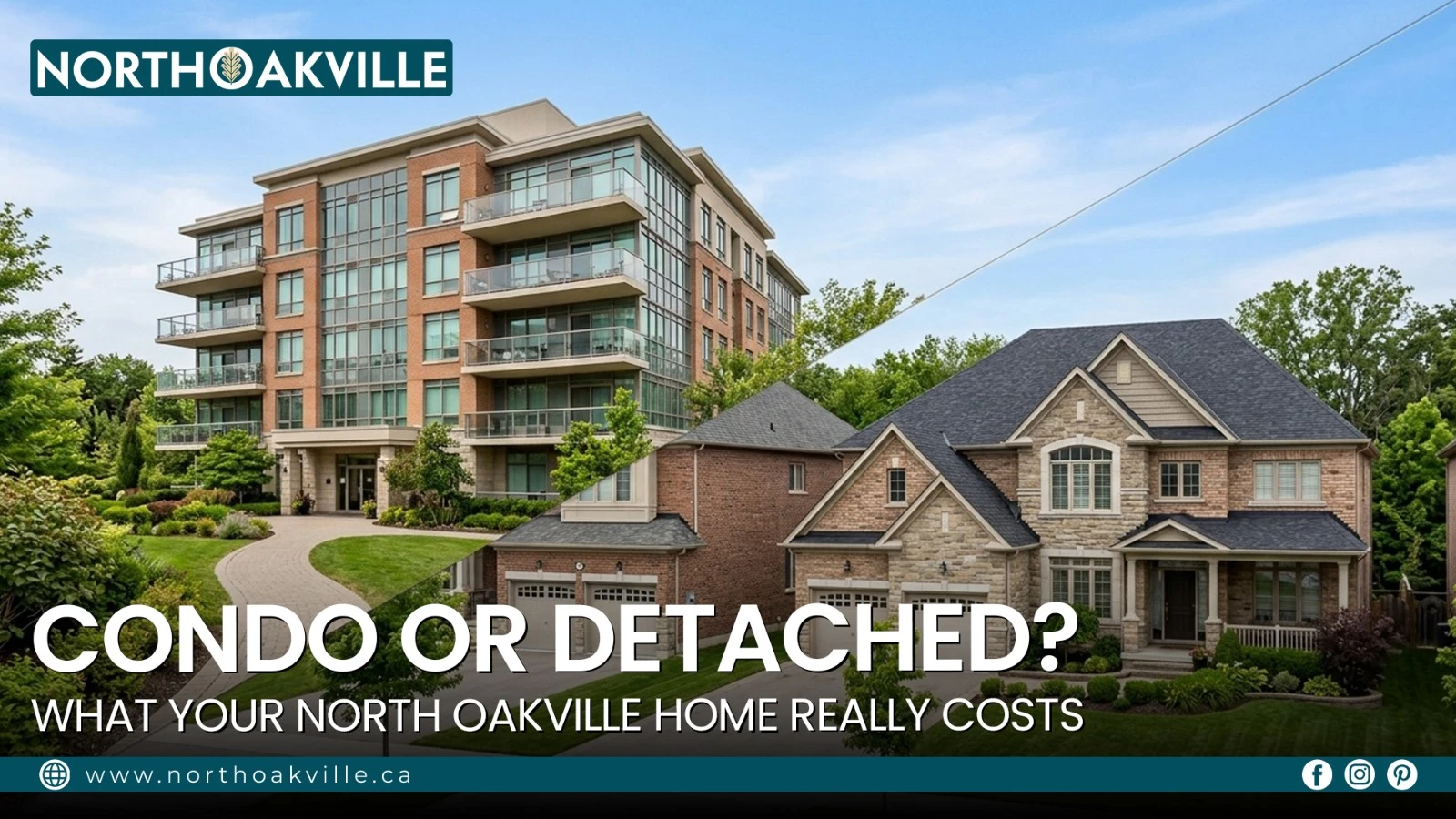
Buying a home in North Oakville usually comes down to one big fork in the road: do you stretch your budget for a detached house, or do you get into the market sooner with a condo apartment?
The price gap between the two is significant. Detached homes in North Oakville typically range from about $1.3 million to $1.85 million, while condo apartments generally sit between $520,000 and $580,000, depending on size, age, location, and whether the property is new construction or resale.
That's a gap of roughly $750,000 to over $1 million between an entry-level condo and an entry-level detached home.
But the sticker price is only the first chapter of the story. A detached home buys private land, significantly more living space, a yard, and parking — along with the full responsibility of maintaining all of it. A condo buys a lower entry price, less exterior upkeep, and a predictable, shared ownership structure — along with monthly fees and less control over the building.
So which one is the smarter buy? That depends on how much capital a buyer can commit, how they plan to use the home, and how they weigh space against simplicity. This condo vs detached North Oakville guide walks through the full comparison — purchase price, closing costs, monthly carrying costs, resale potential, and long-term ownership — so you can see the complete financial picture before deciding.
North Oakville Condo vs. Detached Price Comparison
Property Type | Typical Price Range | Typical Buyer |
|---|---|---|
Condo apartment | About $520,000 – $580,000 | First-time buyers, couples, downsizers, investors |
Detached home | About $1.3M – $1.85M | Families, move-up buyers, long-term homeowners |
These are market-oriented ranges, not fixed prices — individual listings can fall outside them depending on size, condition, lot, and construction quality. North Oakville condo prices tend to cluster more tightly around this range than detached prices do, since unit sizes and building specs are more standardized across new developments.
The gap becomes even clearer once you look at what's actually being purchased. North Oakville detached homes typically come with several bedrooms, multiple bathrooms, private outdoor space, and a garage, while condo apartments offer a far smaller footprint. A detached home isn't simply a "bigger condo" — it's a different type of property with a different ownership structure entirely, and the price reflects that difference.
Why Are Detached Homes So Much More Expensive?
The price gap makes a lot more sense once you break ownership down into its individual components.
Land Is a Major Part of the Price
A detached buyer owns the home and the parcel of land it sits on. That land carries its own market value, and in a growing community like North Oakville, low-density residential land is a limited resource — one reason detached homes in North Oakville continue to command a substantial premium over condo apartments even as new supply comes online. A condo owner, by comparison, owns their individual unit plus a small, shared interest in the condominium corporation's common property — not a piece of land in their own name. This is one of the fundamental reasons detached homes command such a large premium.
Detached Homes Offer Much More Space
North Oakville detached homes commonly offer 2,000+ square feet above grade, with many newer builds ranging well beyond that. Condo apartments, by contrast, can start below 500 square feet, with larger units approaching or exceeding 1,000 square feet at the top end. A buyer choosing a detached home is paying for substantially more usable living space — not just a different postal code.
Bedrooms and Bathrooms Matter
Detached homes in North Oakville are largely designed around family living: four- and five-bedroom layouts, multiple bathrooms, larger kitchens, family rooms, and basement or office space are all common. Condo buildings, on the other hand, are concentrated around one-bedroom, one-bedroom-plus-den, and two-bedroom layouts. For a growing family, the extra rooms are often worth more than their square footage alone would suggest.
Private Outdoor Space
A detached home usually comes with its own front and back yard, a driveway, and private outdoor living space. A condo may offer a balcony or terrace, but any larger green space is shared with the rest of the building's residents. For families with kids or pets, or anyone who simply wants a private outdoor space to call their own, that difference carries real lifestyle value.
Parking and Garages
Detached homes generally come with a private garage and driveway. Condos typically include one underground parking space per unit, with additional parking or storage sometimes available at extra cost. For households with more than one vehicle, this can become a meaningful part of the overall value equation.
The Price Difference Doesn't Tell the Whole Story
A common mistake is comparing only the $550,000 condo to the $1.5 million detached home and concluding the condo is automatically the cheaper choice. The more accurate comparison looks like this:
Purchase price + closing costs + monthly ownership costs + maintenance + taxes + insurance + long-term financial exposure.
That produces a far more realistic picture — and it's where the two property types start to look more comparable than the listing prices alone would suggest.
Closing Costs: Condo vs. Detached
Ontario's Land Transfer Tax (LTT) applies to every property purchase in the province, and it's calculated progressively:
0.5% on the first $55,000
1% on the portion from $55,000 to $250,000
1.5% on the portion from $250,000 to $400,000
2% on the portion above $400,000
Ontario also offers an eligible first-time homebuyer rebate of up to $4,000 off this tax.
Using the purchase prices in the illustrative scenarios below:
Purchase Price | Approx. Ontario LTT |
|---|---|
$550,000 condo | $7,475 |
$1,500,000 detached | $26,475 |
$1,800,000 detached | $32,475 |
Unlike Toronto, Oakville does not levy a separate municipal land transfer tax, so buyers here pay only the provincial rate.
Beyond LTT, buyers should budget for legal fees, title insurance, and registration costs, along with a few property-specific expenses:
Condo buyers should factor in the cost of reviewing the status certificate — a document that outlines the building's finances, reserve fund, and any pending legal issues.
Detached buyers may face inspection, survey, or other due-diligence costs specific to a freehold property.
Exact figures vary by transaction and should always be confirmed with your lawyer and lender.
How Much Cash Could a Buyer Need?
Here's an illustrative breakdown of cash required at closing across three scenarios:
Expense Category | $550K Condo | $1.5M Detached | $1.8M Detached |
|---|---|---|---|
Example down payment | $55,000 | $300,000 | $360,000 |
Ontario LTT | $7,475 | $26,475 | $32,475 |
Legal & other closing costs | ~$1,800–$2,500 | ~$2,100–$3,500 | ~$2,200–$4,000 |
Approx. total cash needed | ~$65,000 | ~$330,000 | ~$396,500 |
Example down payment assumption: $55,000 (10%) for the condo — not the minimum required down payment. Current federal mortgage rules allow insured financing on homes priced below $1.5 million, with the actual minimum calculated as 5% on the first $500,000 and 10% on the portion above that — so a $550,000 condo's legal minimum is closer to $30,000, not $55,000. Homes priced at $1.5 million or more are not eligible for insured mortgages at all, so buyers generally need at least 20% down. That distinction matters when comparing condos at different price points, and it's worth confirming exact numbers with a mortgage broker before assuming a specific down payment amount.
These figures are illustrative examples built around specific down-payment assumptions — not minimum requirements or personalized quotes.
Monthly Ownership Costs Matter Even More
Once the deal closes, the comparison shifts again. A mortgage is usually the biggest monthly expense, but it's far from the only one.
Using a 4.25% mortgage rate and a 25-year amortization as an illustrative benchmark, here's what the full monthly picture can look like:
Monthly Cost | $550K Condo | $1.5M Detached | $1.8M Detached |
|---|---|---|---|
Mortgage payment | ~$2,752 | ~$6,472 | ~$7,766 |
Property tax* | ~$292 | ~$800 | ~$974 |
Condo fee / maintenance | ~$485 | $0 | $0 |
Insurance | ~$40 | ~$140 | ~$170 |
Utilities | ~$80 | ~$400 | ~$460 |
Maintenance reserve | ~$75 | ~$1,250 | ~$1,500 |
Illustrative monthly total | ~$3,724 | ~$9,062 | ~$10,870 |
*The condo mortgage payment above is based on a $495,000 base loan (10% down on $550,000) plus a 3.10% CMHC mortgage insurance premium rolled into the principal — bringing the actual insured mortgage to roughly $510,345. Both detached scenarios assume 20% down, so no insurance premium applies. Property tax examples are based on assessed value, not purchase price — Oakville's residential tax rate applies to the property's MPAC assessment, which can lag behind current market value, especially for newer builds.
And annually, that works out to roughly:
Annual Cost | $550K Condo | $1.5M Detached | $1.8M Detached |
|---|---|---|---|
Estimated annual total | ~$44,700 | ~$108,700 | ~$130,400 |
These numbers are planning examples, not personalized mortgage quotes or guaranteed bills — actual rates, assessments, utilities, insurance, and maintenance needs will vary by buyer and property.
Condo Fees Aren't the Same as an Extra Mortgage Payment
Condo maintenance fees are often the first thing buyers notice when comparing apartments to freehold homes. But the fee pays for services and shared responsibilities that a detached homeowner has to handle entirely on their own — things like:
Common-area maintenance
Building insurance
Snow and garbage removal
Landscaping
Shared amenities
Building management
Reserve-fund contributions
North Oakville condo fees typically run around $0.55 to $0.72 per square foot, though the exact number depends on the building, unit size, and amenities offered.
The more useful question isn't "does this condo have a high fee?" — it's:
"What am I actually getting for that fee, and is the condo corporation financially healthy?"
Before buying, review the status certificate, reserve fund details, and building budget. A well-managed reserve fund protects owners from surprise special assessments down the road.
Detached Homes Have Their Own Version of a Maintenance Fee
Detached owners don't get a monthly maintenance bill — but that doesn't mean maintenance is free. The homeowner is on the hook for the roof, furnace, air conditioning, windows, driveway, landscaping, plumbing, and any other major repair that comes up.
Some years cost very little. Then a roof or an HVAC system fails, and one project creates a large, unplanned bill. A commonly used planning guideline is to budget about 1% of the property's value per year for maintenance and capital repairs — which is why the illustrative reserve above scales with the home's price. It's not a guaranteed annual cost: a newer build may need less in the short term, while an older resale property may need considerably more.
The maintenance reserve shown in the tables above is a planning allowance, not an expected annual bill. In a quiet year, a detached owner may spend far less than that; in a year with a major repair, they may spend considerably more. Think of it as a savings target rather than a monthly invoice.
Property Taxes and Insurance
Property taxes are calculated using a property's assessed value together with the applicable municipal, regional, and education tax rates — not its current market price. Oakville calculates tax bills by applying these rates to the property's MPAC assessment, and newer developments in particular can carry assessments that trail behind actual resale prices. It's also worth remembering that a property's assessment can stay flat in a given year while tax rates themselves change, so last year's bill isn't always a reliable guide to next year's.
Insurance also works differently between the two property types. A detached homeowner typically insures the entire physical structure. A condo corporation carries insurance for the building and common elements — funded through condo fees — while the individual owner only needs a smaller policy covering their unit's contents and personal liability.
Together, these differences are another reason the two property types shouldn't be compared on mortgage payment alone.
Historical Performance: Does Detached Always Win?
Historical Oakville market data has generally shown stronger long-term price growth for detached homes than condos, although performance varies considerably by market cycle and property. Land making up such a significant share of detached home value is one commonly cited reason for that pattern. That said, this doesn't mean every detached property automatically delivers a better investment outcome.
Condo performance can be competitive during periods when detached prices stretch affordability and more buyers shift toward lower-priced housing. It can also vary considerably depending on building quality, fee levels, location, and how much competing inventory is on the market at the time.
The key distinction to keep in mind: higher absolute appreciation doesn't necessarily mean a higher percentage return on the money a buyer actually put in. A lower-priced property can sometimes produce a stronger return on invested capital, depending on financing, rental income, expenses, and market timing.
Resale Demand Is Different for Each Property Type
Condos generally draw from a broader pool of financially qualified buyers, simply because the entry price is lower — first-time buyers, young professionals, couples, downsizers, and investors can all compete for the same unit.
Detached homes have a smaller buyer pool because of the higher financial barrier, but they appeal strongly to families looking for space, private outdoor areas, and access to established suburban neighbourhoods.
A few factors can meaningfully shift resale value on either side:
Location — proximity to major roads, transit, shopping, schools, and trails
Lot size (for detached homes) — width, depth, orientation, and what the property backs onto
Property condition — a well-maintained home is simply easier to sell
Condo fees — rising fees can affect affordability and buyer demand
Building quality — a condo corporation's financial health matters as much as the unit's finishes
Supply — when many similar units hit the market at once, sellers compete harder for buyers
Which Property Type Fits Which Buyer?
Choosing between a detached home and a condo isn't just about price — it's about matching your financial reality with how you actually live. Each property type comes with distinct trade-offs in space, ongoing maintenance, rules, and initial cost. Here is how the choice breaks down for different types of buyers:
Families
For a family that needs four bedrooms, a private backyard, and room to grow, a detached home usually makes the most sense. The higher price buys something a condo often can't offer: space and control — including the freedom to finish a basement, renovate, or reshape the backyard, subject to municipal rules.
First-Time Buyers
For someone getting into the market for the first time, the condo's advantage is straightforward: a lower entry cost and a smaller mortgage that opens the door to buyers who might not qualify for a detached property. The trade-off is condo fees, shared amenities, and condominium rules governing what you can and can't do with the unit. For buyers who value location and affordability more than a yard and extra bedrooms, that trade-off is often worth it.
Investors
This is the least straightforward case. A condo requires less capital and may offer a stronger rent-to-price relationship. A detached home offers land exposure and broader appeal to family tenants, but at a much higher entry cost. Either way, the decision shouldn't rest on historical appreciation alone — investors should run the full math: purchase price, down payment, mortgage cost, taxes, condo fees or maintenance, insurance, expected rent, vacancy, property management, closing costs, and eventual resale costs. The best investment is the one where the numbers still work after every expense is accounted for.
Condo vs. Detached: Quick Comparison
Feature | Condo Apartment | Detached Home |
|---|---|---|
Purchase price | Lower | Much higher |
Land ownership | Shared interest | Exclusive lot |
Living space | Compact | Much larger |
Bedrooms | Usually fewer | Usually more |
Outdoor space | Balcony / terrace | Private yard |
Parking | Building parking | Garage + driveway |
Condo fees | Yes | No |
Exterior maintenance | Mostly shared | Owner's responsibility |
Privacy | Lower | Higher |
Renovation freedom | More restricted | Greater |
Entry cost | Lower | Much higher |
Monthly carrying cost | Generally lower | Generally higher |
Family suitability | Depends on unit | Often stronger |
Long-term land exposure | Limited | Direct |
Resale factors | Building + unit + fees | Land + home + location |
What Buyers Are Really Paying For
When someone pays substantially more for a detached home in North Oakville, that extra money isn't just buying a bigger building. It's buying:
Land ownership — a private parcel, rather than a shared interest in a larger condominium property
Space — often several times the living area of a smaller condo unit
Family capacity — extra bedrooms, bathrooms, and basement space that make room for a growing household
Privacy — no shared walls, ceilings, or floors
Outdoor space — a private yard a condo balcony simply can't replicate
Parking and storage — a private garage and driveway, valuable for multi-vehicle households
Control — considerably more freedom to renovate and modify the property, subject to zoning and permits
A condo buyer, meanwhile, isn't simply buying "less house." They're buying a lower entry cost, less ongoing responsibility, and a more predictable, shared maintenance structure. That distinction is what makes the comparison genuinely meaningful, rather than just a question of who's getting "more" for their money.
Final Thoughts
The biggest mistake in comparing condos and detached homes in North Oakville is looking at the listing price and stopping there.
A condo apartment may cost around half a million dollars, while a detached home can run well past $1 million. That gap is enormous — but it reflects a genuine difference in what the buyer actually owns. A detached home delivers land, significantly more living space, private outdoor areas, parking, privacy, and greater control, which is why it's often the right call for families and long-term homeowners. A condo offers a different proposition: a lower purchase price that makes North Oakville accessible to first-time buyers, professionals, couples, downsizers, and investors who don't need — or want — a large home, in exchange for a monthly fee and shared responsibility for the building.
That financial difference doesn't stop at closing. Across the illustrative scenarios in this guide, the mortgage, taxes, utilities, insurance, and maintenance reserve all combine to make monthly detached ownership considerably higher than condo ownership. None of that automatically makes the condo the "better" choice — it simply means the two properties are built for different needs.
So the right question isn't really "which one is cheaper?" It's:
"Which property gives me the space, ownership benefits, and financial commitments that actually fit the way I want to live?"
For anyone comparing homes in North Oakville, that's the more useful lens for looking at the price gap.
FAQs
Is a condo cheaper than a detached home in North Oakville?
Yes. Condo apartments generally fall in the $520,000–$580,000 range, while detached homes typically range from about $1.3 million to $1.85 million, depending on the property.
How much more does a detached home cost than a condo?
The gap can exceed $750,000 and, in some cases, approach or exceed $1 million, depending on the specific properties being compared.
Are detached homes a better investment than condos?
Not automatically. Detached homes have historically benefited from land ownership and strong family demand, but actual investment performance depends on purchase price, financing, expenses, rental income, condition, and eventual resale value.
Do condos have higher maintenance costs than detached homes?
Not necessarily higher — just structured differently. Condo owners pay a mandatory monthly fee, while detached owners self-fund their own exterior and structural repairs, which tend to be irregular but can be significant (a new roof, for example).
What do North Oakville condo maintenance fees typically cover?
Depending on the building, fees can cover common-area maintenance, building insurance, landscaping, snow removal, garbage services, shared amenities, and reserve-fund contributions. Always check the specific condominium's documents before buying.
What's the biggest advantage of buying a detached home?
Private land ownership, more living space, private outdoor space, parking, privacy, and greater control over renovations.
What's the biggest advantage of buying a condo?
A significantly lower purchase price and financial barrier to entry, plus reduced exterior maintenance responsibility.
Are property taxes higher on detached homes?
Usually, yes — because detached homes generally carry higher assessed values. The actual bill still depends on the property's MPAC assessment and the applicable tax rate, not the purchase price directly.
Does a condo require less money to buy?
Generally, yes. A lower purchase price usually means a smaller mortgage and down payment, though buyers still need to budget for land transfer tax, legal costs, condo fees, and other ownership expenses.
Is a detached home better for a growing family?
Often, yes — more bedrooms, bathrooms, storage, parking, and private outdoor space tend to matter more than a lower up-front cost for families planning to stay long-term.
Can a condo be a good choice for a first-time buyer?
Yes. It offers a lower-cost way into the North Oakville market, though buyers should still review mortgage affordability, maintenance fees, taxes, and the building's financial health before committing.
Should buyers compare mortgage payments or total ownership costs?
Total ownership costs are far more useful. Mortgage payments are only one piece — property taxes, condo fees or maintenance reserves, insurance, utilities, and unexpected repairs all factor into the real monthly cost.
Which is better for long-term ownership: a condo or a detached home?
There's no universal answer. It depends on whether the buyer prioritizes land, space, and privacy, or affordability, convenience, and lower maintenance responsibility.
Can condo fees affect resale value?
Yes. Rapidly rising fees or concerns about a building's reserve fund can make a unit less attractive to future buyers.
What should I check before buying a North Oakville condo?
The status certificate, condominium budget, reserve fund, fee history, any past or pending special assessments, building rules, parking and locker arrangements, insurance, and any ongoing litigation involving the corporation.
Should I choose a condo or detached home based only on appreciation?
No. Historical appreciation is useful context, but it doesn't guarantee future performance. The better decision weighs purchase price, financing, ownership costs, intended use, holding period, and personal financial circumstances together.