Home Security in North Oakville: What's Worth Installing
Which home security upgrades are worth it in North Oakville? Locks, cameras, alarms, insurance discounts, and Ontario privacy rules explained.
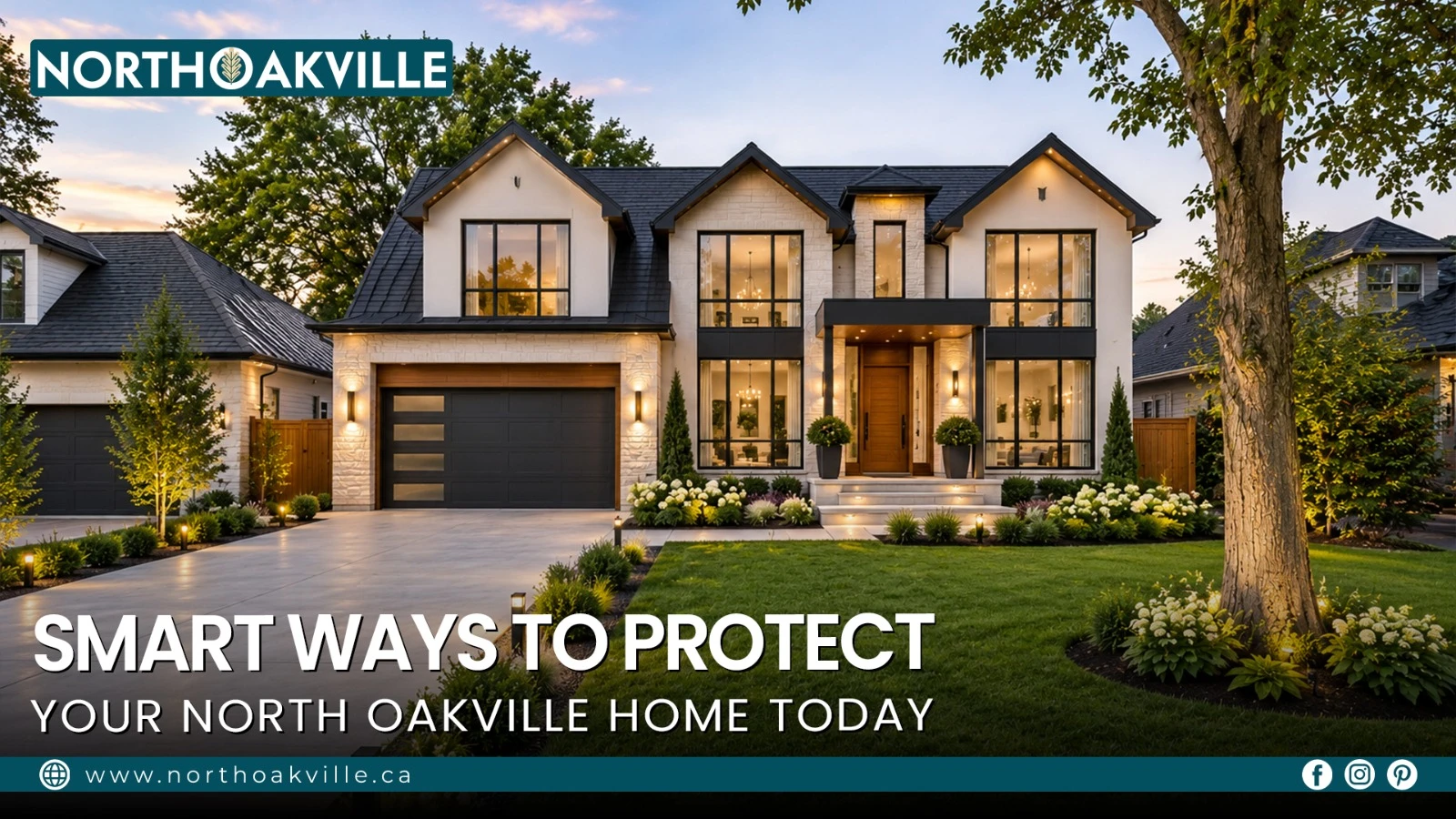
North Oakville is a genuinely safe place to live, and Halton Region consistently ranks among the lowest-crime areas in Ontario. That said, safe doesn't mean risk-free, and the area's newer, fast-growing subdivisions bring a specific set of security considerations that older, established neighbourhoods don't face in quite the same way. This guide walks through what's actually worth installing, what Ontario law says about cameras and self-defence, and how security factors into buying or selling a home here.
Why Home Security Matters in a Newer Community
North Oakville's rapid growth creates a dynamic that's a little different from older parts of town. New subdivisions see heavy daily traffic from construction crews, delivery drivers, and movers, which makes it easier for an unfamiliar vehicle or person to blend in than it would in a long-established neighbourhood where residents know each other's routines and cars on sight.
Vehicle-related theft remains the most common property crime concern across the region, which puts a premium on securing driveways and garages specifically, since most North Oakville homes feature prominent, street-facing driveways and attached garages. The area's abundant trails and ravines are a genuine lifestyle asset, but police in the region have flagged that homes backing onto green space can be more vulnerable at the rear of the property, since these corridors are unlit at night and offer a quiet approach and exit route that a front-facing street doesn't.
Doors, Locks, and Window Security
Good physical security starts with hardware that's actually rated to resist an attack, not just builder-grade minimums.
Look for a deadbolt that carries an ANSI/BHMA Grade 1 rating, the top tier for residential locks, with at least a one-inch bolt throw. Note that Ontario's fire code requires single-cylinder deadbolts on exterior doors specifically so occupants can always exit by hand in an emergency without hunting for a key, so a double-cylinder deadbolt (needing a key on both sides) isn't a legal option for a primary exit door.
A lock is only as strong as what it's anchored into, though. Builder-grade strike plates are often held in with short screws into soft trim, which means a determined kick can split the door frame even with a strong deadbolt in place. Upgrading to a reinforced strike plate with three-inch screws that bite into the structural framing behind the trim is a cheap, high-impact fix. Sliding patio doors, extremely common in the area, deserve particular attention: a basic latch is easy to force or lift out of its track, so a secondary track lock or a horizontal security bar meaningfully raises the difficulty of a break-in through the back of the house.
Entry point | Typical builder-grade setup | Worthwhile upgrade |
|---|---|---|
Front and garage entry door | Basic lockset, shallow bolt | Grade 1 deadbolt with a one-inch throw |
Door frame and strike plate | Short screws into soft trim | Reinforced strike plate with three-inch screws into the framing |
Sliding patio door | Standard handle latch | Track lock or security bar, plus anti-lift hardware |
Ground-floor windows | Factory latch | Secondary window locks or sensors |
Security Cameras: Types and Ontario's Privacy Rules
Cameras generally come in three flavours. Wired, Power-over-Ethernet cameras are the most reliable option, since they're immune to Wi-Fi interference and don't rely on batteries that drain faster in cold weather, though they cost more to install, especially after a home is already finished. Battery-powered wireless cameras install in minutes with no wiring, but Canadian winters are genuinely hard on battery life, and they depend on a stable Wi-Fi signal. Video doorbells cover the single most important vantage point, the front door, but have a narrow field of view and won't help much elsewhere on the property.
Camera type | Power and connection | Main advantage | Main drawback | Best for |
|---|---|---|---|---|
Wired (PoE) | One cable for power and data | Most reliable, works in deep cold, no batteries | Higher install cost, best planned during construction | Driveway and perimeter coverage |
Wireless (battery) | Rechargeable battery plus Wi-Fi | Fast DIY setup, flexible placement | Batteries drain faster in winter, depends on Wi-Fi | Secondary areas and renters |
Video doorbell | Doorbell wiring or battery plus Wi-Fi | Covers the main entry, two-way talk | Narrow field of view | Front porch and deliveries |
Ontario's privacy rules for home cameras are more permissive than many homeowners assume, with a few firm limits. Recording your own property for personal security is broadly exempt from commercial privacy law, and it's legal for your camera to incidentally capture a public sidewalk or street, since there's a lower expectation of privacy in those spaces. What you can't do is deliberately angle a camera to look directly into a neighbour's yard, windows, or other private space, which can expose you to a civil claim. Audio is the stricter issue: under the Criminal Code, recording a private conversation without the consent of at least one participant is a criminal offence, so a camera that continuously records ambient audio from a sidewalk or a neighbour's porch is a real legal risk, even if the video itself is fine. To eliminate any accidental wiretapping risk under Canadian law, the safest practice is to completely disable continuous audio recording on all outward-facing cameras, and keep two-way audio enabled only for actively talking to someone at the door.
Monitored vs. Unmonitored Alarm Systems
An unmonitored system sounds a siren and pushes a notification to your phone, full stop. If you don't see it, nobody is coming. A professionally monitored system is connected to a staffed monitoring station that attempts to verify the alert and can dispatch police, fire, or paramedics directly if it can't reach you, which matters more for households that travel or commute regularly.
One regional detail worth knowing: Halton Regional Police charges the alarm monitoring company a fee, currently $197.75, for dispatches that turn out to be false alarms, and monitoring companies generally pass that cost on to the homeowner. Systems with video verification, where an operator can glance at a camera clip before requesting police dispatch, substantially cut the odds of a false-alarm charge, so it's worth asking about this specifically when comparing providers.
Choosing a Security Provider
Homeowners generally choose between large telecom-bundled security packages, regional alarm companies, and smaller local installers offering contract-free, owned equipment. Whichever route you go, a few questions cut through the sales pitch:
Is the monitoring station ULC-listed? This is the Canadian standard for monitoring station reliability, and some insurance discounts require it.
Does the system have cellular backup, not just Wi-Fi? A cut internet line shouldn't take your whole system offline.
What happens if you sell the home? Ask directly whether the contract and equipment transfer to a buyer, or whether you're on the hook for an early termination fee.
Do you own the equipment, or is it leased? This affects what happens if you switch providers later.
Smart Home Integration
Smart locks, video doorbells, smart lighting, and sensors increasingly work together rather than as standalone gadgets, often through a hub like Apple HomeKit, Google Home, or a dedicated security app. The appeal for North Oakville's newer housing stock is real: smart lighting can randomize while you're away to mimic an occupied home, smart locks log exactly who entered and when, and sensors can trigger exterior lighting or camera recording the instant a window opens.
The trade-off is a genuine cybersecurity surface. The most practical defence is putting smart home devices on a separate guest Wi-Fi network from your computers and banking apps, turning on multi-factor authentication wherever it's offered, and keeping device firmware set to auto-update. A reasonably priced smart lock from an established lock manufacturer, paired with these basic digital hygiene steps, is a sound choice; a cut-rate no-name device with weak encryption is where most of the real risk sits.
Securing a Home That Backs Onto a Trail or Ravine
If your property backs onto one of North Oakville's trails or green corridors, the back of the house deserves more attention than the front. The core idea, sometimes called Crime Prevention Through Environmental Design, is to remove hiding spots and add light rather than build a fortress. Keep foundation shrubs trimmed low enough that they don't block sightlines to ground-floor windows, and prune low tree branches so there's nowhere to lurk unseen. Motion-activated floodlights covering the rear yard are one of the higher-value, lower-cost upgrades available, since a sudden burst of light removes an intruder's cover instantly. Given that rear sliding doors are a common target, reinforcing that door specifically, with a track lock and security film, is worth prioritizing over, say, a second front-door camera.
Garage and Driveway Security
Because so much property crime in the region centres on vehicles, the garage deserves real attention. A smart opener with built-in alerts tells you immediately if the door is left open. An automatic close timer closes it after a set period if someone forgets. And a secondary mechanical lock on the garage door track defeats "garage fishing," where an intruder slides a tool through the weatherstripping to pull the emergency release cord from outside. Most openers also have a vacation or lock mode that disables the wireless remote entirely, which protects against code-grabbing devices used by some vehicle thieves.
New Construction: What Builders Include and What's Worth Upgrading
Most new homes in North Oakville ship with a basic security rough-in: low-voltage wiring run from the main entry points to a central panel, plus hardwired, interconnected smoke and carbon monoxide detectors, which the Ontario Building Code requires on every floor regardless of any alarm package. Builders commonly offer upgrades at the design stage, like structured Cat6 wiring to exterior points for future cameras, which is worth serious consideration if you're buying pre-construction.
The reason is simple: running wire through open wall studs during framing takes a contractor minutes and costs relatively little, while fishing the same wire through finished drywall, paint, and trim later is slow, messy, and considerably more expensive. If you're customizing a pre-construction home, this is one of the clearest cases where paying a modest amount upfront saves real money and hassle down the road.
Visible Deterrents: Signs, Cameras, and Dogs
A security company's yard sign or window decal can genuinely deter an opportunistic intruder, since it signals the home is actively monitored, but a generic, unbranded sign bought online is less convincing and may do little. Fake cameras are generally not worth it. Experienced intruders recognize the telltale signs of a dummy unit, and discovering one can actually signal to them that the home's security is weaker than it looks. A dog, even a small one, remains one of the more effective deterrents around, mostly because barking removes the element of surprise and draws attention, not because of size or aggression.
Informal digital neighbourhood groups, whether a local Facebook group or a similar app, have also become a meaningful layer of community security in newer subdivisions, since they let residents quickly share a description of a suspicious vehicle or person across an entire street or block.
Home Insurance and Security Systems
Installing a monitored alarm system can lower your home insurance premium in Ontario, commonly somewhere in the range of 5 to 15%, with the higher end often tied to systems that also include monitored smoke, carbon monoxide, and water leak detection, since water damage is consistently one of the largest sources of home insurance claims. To actually claim the discount, insurers generally want documentation, typically a monitoring certificate or letter from your provider confirming the system is professionally monitored and specifying what it covers. A standalone smart camera that only pushes alerts to your phone, with no professional monitoring behind it, usually doesn't qualify for a discount, since insurers are specifically rewarding the guarantee that someone responds even if you don't see the alert.
Leaving Home for Extended Periods
Most Ontario home insurance policies include a winter vacancy clause that matters more than people expect: leave a home unattended for roughly four consecutive days during the heating season without arrangements for someone to check on it, and a frozen-pipe or water damage claim can be denied outright. The safest approach is shutting off the main water valve and draining the lines if you'll be away for an extended stretch, and arranging for a trusted person to physically check the home periodically, not just glance at a camera feed. Also worth doing: pausing mail delivery, arranging snow clearing so the driveway doesn't visibly pile up, and activating your garage opener's vacation lock mode. Halton Police don't offer a check-in service for routine vacations, so the practical move is simply looping in a trusted neighbour rather than calling non-emergency lines.
Use of Force and Self-Defence Law in Ontario
Canada doesn't have a "castle doctrine," and it's worth being clear-eyed about this. Self-defence is governed by Section 34 of the Criminal Code, and any use of force against an intruder has to be genuinely for the purpose of protecting yourself or others, not retaliation, and reasonable in the circumstances. Courts weigh factors like the immediacy of the threat, whether retreating or calling police was a realistic option, and the relative size and circumstances of everyone involved. Defending property alone, say, stopping someone from stealing a car out of the driveway, carries a much lower threshold for acceptable force than defending a person from physical harm. The practical takeaway for a blog like this isn't legal advice, it's that a good alarm, good lighting, and a locked door that actually holds are a far more reliable strategy than planning to physically confront an intruder.
Access Control: Smart Locks and Shared Codes
A quality smart lock from an established manufacturer, ideally one without a traditional keyway at all, offers physical security comparable to a standard deadbolt while adding something a mechanical lock can't: a log of who came and went, and when. That's genuinely useful for coordinating a dog walker, a contractor, or a cleaner without handing out a physical key that can be copied. Good practice is giving each person their own code rather than one shared master code, restricting a contractor's code to specific hours if your app supports it, and using time-limited codes for one-off situations like a delivery or a short-term guest. Turning on auto-lock so the door secures itself shortly after closing removes the most common human error, simply forgetting to lock up.
What This Means for Buying or Selling a Home
A security system doesn't move the needle much on a formal bank appraisal, but it genuinely affects how a property shows and how competitive it feels to buyers comparing similar homes. A property described as smart-home ready, with pre-installed cameras, a smart lock, and integrated garage monitoring, tends to stand out in a market where floor plans are often very similar across a subdivision, and buyer surveys consistently show a strong preference for homes with existing smart technology over ones requiring it to be added.
If you're touring a home, it's worth looking past the finishes and checking the security bones directly. Ask whether there's a dedicated wiring panel or Cat6 runs to the exterior, since retrofitting that later is expensive. If the home backs onto a trail or green space, look specifically at whether the rear sliding door has reinforced locking hardware and whether motion lighting is already installed. And if smart locks, cameras, or a garage hub are staying with the home, make sure they're explicitly listed as included chattels in the purchase agreement, and confirm the service isn't locked into a multi-year contract that doesn't transfer to a new owner.
Costs and Budgeting
A basic do-it-yourself setup, a hub, a few door and window sensors, a motion sensor, and a video doorbell, typically runs somewhere in the low hundreds of dollars upfront with no installation labour, since you're mounting and pairing everything yourself. A fuller, professionally installed system with hardwired cameras and clean wiring runs considerably more, often well into four figures, but delivers a cleaner finish and generally more reliable hardware.
Ongoing costs are worth budgeting for too. Professional monitoring typically runs somewhere between roughly $15 and $60 a month depending on the provider and whether cloud video storage is bundled in, and if you want video history without monitoring, standalone cloud storage plans are usually priced separately, or can be avoided entirely with a camera system that stores footage locally. Outdoor battery-powered devices also mean a real, if modest, annual cost in battery replacements, since cold weather drains them faster than a mild climate would.
Final Thoughts
Home security in North Oakville isn't about treating a genuinely safe community like a high-risk zone. It's about matching a handful of smart, targeted upgrades, solid door hardware, good exterior lighting, a monitored system if it fits your lifestyle, to the specific realities of newer subdivisions and trail-adjacent lots. Done well, it's also a detail that quietly works in your favour whether you're settling into a home for years or getting it ready to list.
Security costs, insurance discounts, and local fees change over time. Confirm current details directly with the Town of Oakville, Halton Regional Police, your insurance provider, and individual security companies before making decisions.
FAQs
Will a home security system lower my home insurance in Ontario?
Often, yes. A professionally monitored alarm system commonly earns a discount somewhere in the 5 to 15% range, with systems that also monitor for water leaks and fire typically qualifying for the higher end, provided you can supply your insurer with proof of professional monitoring.
What is the fine for a false alarm in Halton Region?
Halton Regional Police charges a $197.75 fee to the alarm monitoring company for a dispatch that turns out to be false, which monitoring companies typically pass along to the homeowner. Choosing a system with video verification meaningfully reduces the odds of this happening.
Is it legal to have outdoor security cameras that record audio in Canada?
Video of your own property and incidental public spaces like a sidewalk is generally legal. Audio is riskier: recording a private conversation without the consent of at least one participant can violate the Criminal Code, so many homeowners disable continuous audio recording on outward-facing cameras.
Do wireless security camera batteries die faster in Canadian winters?
Yes, cold temperatures reduce battery performance and drain outdoor devices faster than they would in a mild climate, which is a real factor for North Oakville homeowners choosing between wireless and hardwired camera systems.
Is it better to get a hardwired or wireless security system for a new build?
If you're building or customizing a pre-construction home, running wiring during framing is cheap and easy compared to retrofitting a finished home later, which makes hardwired, Power-over-Ethernet cameras a strong option worth considering at the design stage.