North Oakville vs Milton vs Burlington: Where Should You Buy?
Compare North Oakville, Milton and Burlington on home prices, schools, GO commute, taxes, safety and lifestyle to find where to buy in Halton Region.
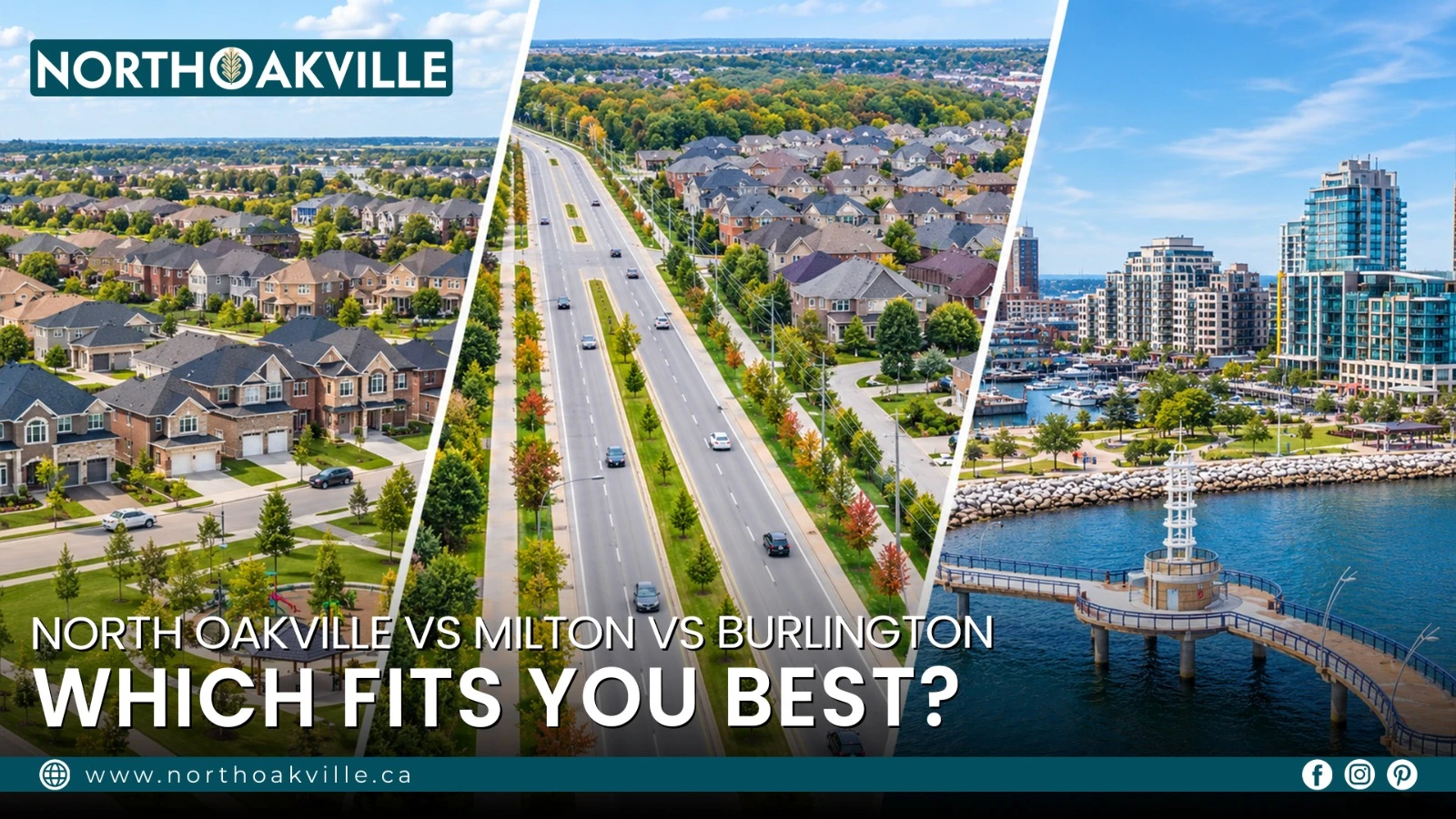
If you are looking for a home in the west GTA, chances are North Oakville, Milton and Burlington are all on your list. All three sit in Halton Region, all three are known for safe communities and strong schools, and all three are a reasonable drive from Toronto. Yet day-to-day life in each one feels quite different.
So where should you buy? It depends on your budget and priorities. Milton generally gives you the most space and the newest homes for your money. North Oakville suits buyers who want a modern, master-planned community, well-regarded schools and a faster GO train ride to Toronto. Burlington suits those who want a relaxed lakeside city, mature lots and flexible transit.
This guide walks through each area side by side, so you can see how they compare on price, housing, taxes, schools, commuting, amenities, safety and long-term value.
North Oakville vs Milton vs Burlington at a Glance
Feature | North Oakville | Milton | Burlington |
|---|---|---|---|
Primary vibe | Modern, master-planned, upscale | Young, family-focused, outdoorsy | Balanced, mature, lakeside |
Housing stock | Post-2000 builds, compact lots, townhomes | Mostly newer master-planned communities | Established tree-lined lots plus new core condos |
Detached price range | Roughly $1.3M to $2.1M+ | Roughly $1.0M to $1.4M | Roughly $1.3M to $1.6M |
GO train to Toronto | About 35 to 40 mins (all-day service) | About 60 to 90 mins (mostly peak hours) | About 45 to 55 mins (all-day service) |
Highway access | 407 and 403 | 401 and 407 | QEW and 407 |
1. Lifestyle and Community Character
All three belong to Halton Region, but each was shaped by a different development story, and that shows in how daily life feels.
Category | North Oakville | Milton | Burlington |
|---|---|---|---|
Character | Modern, higher-density, master-planned neighbourhoods | Fast-growing, family-centric, close to nature | Mature, balanced, established lakeside city |
General vibe | Polished, upscale, well organized | Active, community-minded, outdoorsy | Laid-back, scenic, culturally rich |
Typical buyers | Professionals, higher-income families, move-up buyers | First-time buyers, newcomers, growing families | Established families, professionals, retirees and downsizers |
Lifestyle anchors | Oakville Trafalgar Memorial Hospital, Sixteen Mile Sports Complex | Niagara Escarpment, Kelso Conservation Area, Mattamy National Cycling Centre | Spencer Smith Park, Waterfront Trail, Downtown Burlington |
North Oakville: Modern and Master-Planned
North Oakville generally refers to the area north of Dundas Street up to Highway 407. Because almost everything here was built after 2000, you will find clean street grids, consistent architecture and neighbourhood plazas close to home. It does not have the mature tree canopy of South Oakville, but it makes up for it with energy-efficient homes and convenience. Communities like The Preserve and Glenorchy are good examples, with townhomes, compact detached homes and mid-rises close to everyday retail such as the Uptown Core. If you want a closer look at specific pockets, explore our North Oakville neighbourhood guide.
Milton: Active and Family-Oriented
Milton sits at the base of the Niagara Escarpment, and outdoor life is a big part of its identity. Neighbourhoods like Harrison and Boyne are filled with newer detached homes and rear-lane townhomes, local sports leagues and busy parks. Weekends often mean a trip to Kelso for hiking, mountain biking or skiing, or an event at the Mattamy National Cycling Centre.
Burlington: Established and Waterfront
Burlington feels like a complete city rather than a commuter suburb. Downtown along Brant Street and Lakeshore Road has boutiques, restaurants and lakeview condos. Southern neighbourhoods like Roseland have wide, tree-lined streets and larger lots, while north Burlington areas such as Alton Village offer newer layouts closer to what you see in Milton. Residents gather at Spencer Smith Park for events like the Sound of Music Festival.
Who Usually Chooses Each Area?
North Oakville: buyers who value an Oakville address, strong school catchments and a quicker commute to downtown Toronto.
Milton: first-time buyers, newcomers to Canada and young families who want the most space for their budget.
Burlington: mid-career professionals, families who want mature yards, and retirees or downsizers who like a walkable lakeside setting.
2. Home Prices and Market Conditions
Recent TRREB market reports show a more balanced, price-sensitive market across Halton, where buyers have more choice and more room to negotiate than they did at the market's peak. The figures below are approximate resale benchmarks. North Oakville is a sub-area, so its numbers are generally based on broader Oakville data and should be read as a guide rather than an exact figure.
Metric | North Oakville | Milton | Burlington |
|---|---|---|---|
Blended average resale price | About $1.32M | About $978K | About $1.02M |
Detached average | About $1.58M to $1.79M | About $1.24M | About $1.42M |
Freehold townhouse average | About $950K to $1.1M | About $800K | About $850K to $920K |
Condo apartment average | About $550K to $650K | About $500K to $580K | About $600K to $680K |
Price per sq. ft. | About $850 to $950 | About $650 to $720 | About $750 to $850 |
Average days on market | About 39 days | About 29 days | About 38 days |
Months of inventory | About 4.6 | About 2.5 to 3 | About 3.5 |
Market feel | Leans buyer's market | Balanced to tight | Balanced |
How Prices Have Moved
Past year: average prices have softened slightly in Oakville and Burlington as buyers gained more choice and negotiating power.
Past three years: prices have largely flattened after the rate-hike cycle, sitting somewhat below their peak levels.
Past five years: longer-term equity is still positive, though gains have moderated compared with the very hot market of early 2021.
Price Outlook
Many market analysts expect inventory to tighten as new listings slow, which could support modest price growth in the coming years, often discussed in the range of 3% to 5% annually once interest rates and employment settle. Forecasts are never guaranteed, so treat this as general direction rather than a promise.
What Can You Buy at Different Budgets?
Around $1 million
North Oakville: a modern two-bedroom stacked townhome or a two-bedroom plus den condo.
Milton: a freehold three-bedroom townhouse or a smaller semi-detached home.
Burlington: a spacious three-bedroom townhome or an older semi in areas like Palmer or Brant Hills.
Around $1.5 million
North Oakville: a modern three-bedroom row townhome or a compact detached home on a narrow lot.
Milton: a newer executive detached home, often four to five bedrooms and 2,500+ sq. ft.
Burlington: a three to four-bedroom detached home from the 1970s to 80s on a wide mature lot, in pockets like Headon Forest or Mountainside.
Around $2 million
North Oakville: a premium, newer detached home with four to five bedrooms and high-end finishes, such as in The Preserve.
Milton: a custom luxury home, an escarpment-view property or a top-tier detached home on an exclusive street.
Burlington: an updated detached home in sought-after areas like Millcroft, or a premium property within walking distance of downtown and the lake.
Household Income Typically Needed
Assuming 20% down, a 25-year amortization and a stress test at current fixed rates around 6%, the rough qualifying household incomes are:
Milton (about $977K): around $190,000
Burlington (about $1.02M): around $200,000
North Oakville (about $1.32M): around $255,000 or more
These are estimates only. Your own number will depend on your down payment, debts and lender.
Which Area Offers the Best Value?
Most space and newest home per dollar: Milton. Detached homes there are often several hundred thousand dollars below Oakville.
Best lifestyle value: Burlington. It is generally more affordable than Oakville while offering a waterfront core, larger mature lots and all-day GO service.
Best for prestige and school catchments: North Oakville, at a higher entry price.
Ready to see what your budget buys? Browse the latest North Oakville new listings, or check recently sold homes in Rural Oakville to understand how quickly homes are moving.
3. Housing Types and New Developments
North Oakville and Milton are the region's main greenfield growth areas. Burlington is largely built out, so new development there is mostly vertical.
Category | North Oakville | Milton | Burlington |
|---|---|---|---|
Dominant housing | Townhomes, stacked towns, compact detached homes | Rear-lane freehold townhomes, large two-storey detached | Mature bungalows and split-levels, plus high-rise condos |
Typical home age | New (roughly 0 to 15 years) | Mostly new (roughly 0 to 20 years) | Mature in the south (30 to 50+ years), newer in the north |
Typical lot frontage | Narrow, about 20 to 36 ft | About 30 to 45 ft | Wide, often 50 to 60+ ft in the south |
Pre-construction volume | High (low-rise and mid-rise) | High (phased low-rise) | Moderate to high (mostly high-rise condos) |
North Oakville
Officially, North Oakville covers the lands north of Dundas Street up to Highway 407, between Ninth Line and Tremaine Road. Key communities include The Preserve, Glenorchy and ongoing low-rise and mid-rise releases along the Trafalgar Road corridor. Active builders include Mattamy Homes, Great Gulf, Greenpark, Fernbrook and Branthaven. Homes tend to have stone and brick fronts, efficient mechanical systems and modern layouts, with tight setbacks between houses.
Milton
Milton continues to grow south and east. The Boyne Survey is now largely established, while newer growth areas include the Britannia Secondary Plan and the Derry Green and Trafalgar corridor lands. Builders such as Mattamy, Fieldgate, Coscorp and Great Gulf offer larger layouts with slightly wider lots than you will usually find in North Oakville.
Burlington
With limited room to expand, Burlington's growth is about intensification:
Downtown and waterfront: boutique high-rises and mixed-use towers around Brant Street and Lakeshore Road.
Uptown (Appleby and Alton): older low-rise neighbourhoods alongside newer mid-rise and high-rise transit-oriented projects.
Aldershot: stacked townhomes and condo communities forming around the GO station.
Which Area Has the Most Pre-Construction Opportunity?
For freehold townhomes and detached homes, Milton and North Oakville offer the most options. Milton is more affordable per square foot, while North Oakville commands higher prices. For high-rise condos, Burlington leads, especially near its three GO stations.
New Build vs Resale
New build
Pros: Tarion warranty coverage (including deposit protection and structural coverage for up to seven years), modern systems and design choices.
Cons: closing adjustments such as development charges, utility hookups and Tarion enrolment can add roughly $15,000 to $45,000, plus possible construction delays and living near active construction.
Resale
Pros: price certainty, established amenities, mature trees and known school catchments.
Cons: possible near-term costs like roofs, HVAC or basement upgrades, and dated layouts that may need renovation.
4. Property Taxes and Cost of Living
Property tax is calculated by multiplying your MPAC-assessed value by the combined municipal, regional and education rate. Assessed values are often lower than current market values.
Municipality | Residential tax rate (approx.) | Tax on $600K assessment | Tax on $1M assessment |
|---|---|---|---|
Oakville (incl. North Oakville) | 0.851% | About $5,106 | About $8,510 |
Milton | 0.864% | About $5,182 | About $8,636 |
Burlington | 1.015% | About $6,092 | About $10,153 |
Oakville has the lowest rate, though a higher home price means the actual dollars paid can end up similar to the others.
Everyday Cost of Living
Utilities: newer homes in North Oakville and Milton tend to be more energy efficient than older homes in south Burlington.
Auto insurance: Milton drivers may see slightly higher premiums due to long highway commutes.
Transportation: Milton commuters often lean on Highway 407, which adds toll costs, while Oakville and Burlington residents can use the Lakeshore West GO line to reduce driving.
Extra Costs to Plan For
Ontario land transfer tax: about $16,475 on a $1,000,000 purchase. Halton has no additional municipal land transfer tax, unlike Toronto.
Condo and maintenance fees: commonly around $0.55 to $0.75 per sq. ft. in high-rises and stacked townhomes, common in Burlington's core and North Oakville.
New-build closing costs: development charges, Tarion enrolment and utility connections, roughly $15,000 to $45,000.
Investor note: pre-construction buyers purchasing as a rental may need to pay the HST new housing rebate portion up front and recover it later. Speak with an accountant about your situation.
Use our Land Transfer Tax Calculator and mortgage calculators to estimate your closing and monthly costs.
First-Time Buyer Programs
Ontario Land Transfer Tax Rebate: up to $4,000 for eligible first-time buyers.
First Home Savings Account (FHSA): up to $8,000 per year, $40,000 lifetime, with tax-deductible contributions and tax-free qualifying withdrawals.
Home Buyers' Plan (HBP): withdraw up to $60,000 from your RRSP tax-free, repaid over 15 years.
Program limits can change, so confirm the latest details with official sources or your advisor.
5. Schools and Education
Public schooling is handled by the Halton District School Board (HDSB) and Catholic schooling by the Halton Catholic District School Board (HCDSB). All three areas perform above the Ontario average on EQAO testing and Fraser Institute ratings.
Category | North Oakville | Milton | Burlington |
|---|---|---|---|
Notable high schools | White Oaks Secondary, with partial Iroquois Ridge and Oakhaven catchments | Milton District, Craig Kielburger, St. Francis Xavier (Catholic) | Dr. Frank J. Hayden, Nelson, Corpus Christi (Catholic) |
Fraser Institute picture | Generally very high, with some Oakville schools near 9/10 and northern pockets around 7 to 8/10 | Consistently strong, roughly 7 to 8/10 | Strong and stable, roughly 7.5 to 8.2/10 |
Growth impact | Some portable use as new areas fill in | New schools built to keep up with growth | Mature, stable catchments |
Ratings change each year, so check the latest Fraser Institute and EQAO results before relying on any single score.
French Immersion, IB and AP
North Oakville: French immersion through schools like Forest Trail (elementary) and Garth Webb Secondary. White Oaks is a recognized IB school, and AP options exist at several secondary schools.
Milton: French immersion at Milton District and Craig Kielburger, and within the Catholic board. The Catholic AP program is centred at Bishop P. F. Reding.
Burlington: French immersion at designated hubs such as M.M. Robinson, and AP streams at schools like Assumption Secondary.
Private Schools
Oakville is home to Appleby College and St. Mildred's-Lightbourn School. Milton and Burlington have smaller independent options, but families looking for long-established private prep schools often look to Oakville or Mississauga.
Colleges and Universities
Milton: the Milton Education Village, a growing campus district with Wilfrid Laurier University and Conestoga College.
Oakville: Sheridan College's Trafalgar Road Campus.
Burlington: close to McMaster University in Hamilton, often reachable in under 20 minutes from south Burlington.
For more detail, see our curated guides to schools in North Oakville.
6. Commute and Transportation
Commuting is often what separates these three areas most clearly.
Destination | North Oakville | Milton | Burlington |
|---|---|---|---|
Downtown Toronto | GO train 35 to 40 mins; drive at peak 65 to 90+ mins | GO train 75 to 90 mins; drive at peak 80 to 110+ mins | GO train 45 to 55 mins; drive at peak 75 to 100+ mins |
Mississauga (Square One) | 20 to 30 mins | 25 to 40 mins | 35 to 50 mins |
Downtown Hamilton | 30 to 40 mins | 35 to 45 mins | GO 12 to 18 mins; drive 15 to 25 mins |
Pearson Airport | 30 to 40 mins | 25 to 35 mins | 40 to 55 mins |
These are estimates. Actual times vary with traffic and train schedules.
GO Train Service
Lakeshore West (North Oakville and Burlington): all-day, two-way service seven days a week, with trains typically every 15 to 30 minutes, plus express trips at rush hour.
Oakville stations: Oakville GO and Bronte GO
Burlington stations: Appleby, Burlington and Aldershot GO
North Oakville residents usually drive about 10 to 15 minutes south to reach a station. Planning the daily trip? Here is more on the commute from North Oakville to Toronto.
Milton Line: mainly a weekday, peak-direction service, with roughly ten Toronto-bound morning trips and nine afternoon returns. Off-peak and weekend travel generally relies on buses and connections. Expansion plans exist, but the line remains peak-focused for now.
Highway Access
North Oakville: Highway 407 along the north edge, with quick access to the 403 and QEW.
Milton: Highway 401 and 407, with Regional Road 25 linking south to Oakville.
Burlington: QEW, 403 and 407, which makes Hamilton, Niagara and Toronto all accessible.
Local Transit and Traffic
Burlington Transit is often viewed as the strongest of the three thanks to better GO station integration, while Oakville Transit and Milton Transit are still catching up with rapid growth. At rush hour, expect slowdowns on the QEW toward Toronto for Oakville and Burlington drivers, around the 401/407 area for Milton, and on Trafalgar Road and Dundas Street near schools and GO stations in North Oakville.
7. Amenities, Shopping and Dining
Category | North Oakville | Milton | Burlington |
|---|---|---|---|
Shopping | Oakville Place, Uptown Core plazas (Dundas and Trafalgar) | Milton Mall, Toronto Premium Outlets nearby | Mapleview Shopping Centre, Burlington Centre |
Grocery anchors | Longo's, Walmart, Real Canadian Superstore, Fortinos | Real Canadian Superstore, Metro, Sobeys, Food Basics | Farm Boy, Longo's, Denninger's, Marilu's Market |
Recreation | Sixteen Mile Sports Complex, Trafalgar Park Community Centre | Mattamy National Cycling Centre, Milton Sports Centre | Haber Community Centre, Tansley Woods, Mainway Arena |
North Oakville: convenience is the strength. Groceries, fitness, clinics and restaurants cluster around the Dundas and Trafalgar intersection. Dining leans toward modern chains and quick-service spots, and residents often head south to Downtown Oakville for independent cafés and fine dining.
Milton: everyday shopping is centred on Maple Avenue and Louis St. Laurent Avenue. Main Street has local pubs, cafés and trattorias, and there is community theatre at FirstOntario Arts Centre Milton.
Burlington: the most varied independent dining scene, especially downtown, plus the Performing Arts Centre and the Art Gallery of Burlington.
Hospitals and Healthcare
North Oakville: Oakville Trafalgar Memorial Hospital, a large modern facility opened in late 2015 near Dundas Street and Third Line.
Milton: Milton District Hospital on Derry Road, expanded significantly to serve a growing population.
Burlington: Joseph Brant Hospital on the waterfront, with a modern patient care tower and links to McMaster in Hamilton.
You can also browse our list of healthcare options in North Oakville.
Walkability
Area | Approx. Walk Score | What it means |
|---|---|---|
Burlington | About 60 to 65 in core areas | Downtown is very walkable, while northern pockets are car-dependent |
North Oakville | About 45 to 50 | Parks and plazas are walkable, but most errands still need a car |
Milton | About 35 to 40 | Largely car-dependent |
8. Parks, Nature and Recreation
Category | North Oakville | Milton | Burlington |
|---|---|---|---|
Natural anchors | Sixteen Mile Creek valleylands, Lions Valley Park | Niagara Escarpment, Kelso, Rattlesnake Point, Crawford Lake | Spencer Smith Park, Royal Botanical Gardens, Mount Nemo |
Water access | Creek valleys and ponds; Lake Ontario is a short drive south | Inland reservoir beach and escarpment lakes | Direct lakefront with beaches, boardwalks and a marina |
Trails | Heritage trails, woodlot loops | Bruce Trail, cliff-edge paths | Waterfront Trail, RBG trail system |
Winter sports | Local rinks and arenas | Glen Eden Ski and Snowboard Centre | Tyandaga trail loops, indoor facilities |
North Oakville: was planned around conservation, with creek-side trails and wooded valleys close to newer subdivisions.
Milton: is the outdoor-adventure pick. Kelso offers swimming, paddleboats and hiking, with climbing at Rattlesnake Point. The Mattamy National Cycling Centre is home to Canada's Category 1 indoor velodrome, and also has courts and walking tracks for the public. Milton Sports Centre adds multiple ice pads and a pool.
Burlington: offers the strongest lakefront access, with Spencer Smith Park, the Brant Street Pier and the Waterfront Trail. Golfers can choose from Tyandaga and Millcroft, among others.
Sixteen Mile Sports Complex in North Oakville has several ice pads, including a large rink with seating for about 1,500, and anchors local hockey, skating and lacrosse.
Bruce Trail and Glen Eden: the Bruce Trail passes through Milton and north Burlington, with lookouts at Mount Nemo and Hilton Falls. Glen Eden offers around 12 runs and several terrain parks.
9. Safety and Community
Halton Region is consistently recognized as one of the safest large policing jurisdictions in Ontario, with Statistics Canada and Halton Regional Police data showing low crime severity and relatively low violent and property crime. Recent Halton Regional Police reporting also pointed to year-over-year declines in auto theft and home break-ins.
Metric (approx.) | North Oakville | Milton | Burlington |
|---|---|---|---|
Crimes per 100,000 residents | About 1,838 | About 1,907 | About 2,647 |
Violent crime per 100,000 | About 472 | Low | Below the Ontario average |
Main concerns | Retail theft, auto theft attempts | Mischief, commuter-area auto theft | Commercial break-ins, downtown petty theft |
All three are well below the Ontario average of roughly 4,500 incidents per 100,000 people. Figures are based on reported data and different geographic boundaries, so use them as a general comparison.
How Residents Feel
North Oakville: active, walkable streets in communities like The Preserve are often cited as a safety positive.
Milton: neighbourhood watch groups and a family-heavy population contribute to a strong sense of security.
Burlington: residents commonly report feeling comfortable in the downtown core and along the waterfront.
Community Events
North Oakville: tournaments and cultural events at Sixteen Mile Sports Complex, plus active neighbourhood and parent groups.
Milton: the Milton Fall Fair, Downtown Milton Street Festival, minor sports leagues and cycling events.
Burlington: Sound of Music Festival, Ribfest, Art Gallery exhibitions, and sailing and community service clubs.
10. Demographics and Diversity
Metric (approx.) | North Oakville | Milton | Burlington |
|---|---|---|---|
Population | About 42,000+ (expected to grow toward 75,000 at build-out) | About 148,000 | About 195,000 |
Growth | Very rapid | Strong | Slow and steady |
Median age | About 34.8 | About 35.6 | About 43.2 |
Average household income | About $192,000 | About $144,500 | About $138,000 (detached pockets higher) |
Visible minority share | About 52% | About 56% | About 18% |
These are estimates drawn from planning data and census-based sources. Exact numbers vary by boundary and year.
What Drives Growth
North Oakville: secondary plan development north of Dundas Street, attracting professionals from Toronto and Mississauga who want a new home and strong schools.
Milton: new master-planned phases and the Milton Education Village are drawing young families and first-time buyers.
Burlington: with limited land, growth comes from condo infill near GO stations and downtown, attracting young professionals and downsizers.
Diversity and Cultural Amenities
North Oakville and Milton are both highly multicultural, with South Asian, Middle Eastern and East Asian grocers, restaurants, places of worship and community centres. Burlington is less diverse overall, though its northern areas are changing, and residents may drive 10 to 15 minutes east for more specialized cultural options.
11. Investment and Rental Potential
Metric (approx.) | North Oakville | Milton | Burlington |
|---|---|---|---|
1-bed condo rent | $2,350 to $2,500 | $2,100 to $2,250 | $2,250 to $2,400 |
2-bed condo rent | $2,750 to $3,000 | $2,450 to $2,650 | $2,650 to $2,850 |
3-bed townhouse rent | $3,300 to $3,600 | $2,900 to $3,200 | $3,100 to $3,400 |
4-bed detached rent | $4,200 to $5,000+ | $3,600 to $4,100 | $3,800 to $4,500 |
Gross rental yield | About 3.2% to 3.8% | About 4.0% to 4.5% | About 3.5% to 4.0% |
Appreciation outlook | Strong, premium location | Moderate to strong | Strong and steady |
North Oakville: best suited to long-term equity growth. Higher purchase prices compress yields, so investors should be prepared for tighter or negative cash flow and a larger down payment.
Milton: the cash-flow leader, with the lowest entry price and strong demand from young families. Ongoing new supply may temper rapid price spikes.
Burlington: a balanced, lower-risk option. Limited land supports value over time, and transit-friendly condos and downtown rentals draw steady tenants.
Rents and yields shift with the market, so confirm with current listings and a licensed professional before making investment decisions.
12. Pros and Cons of Each Area
North Oakville
Pros
Prestigious Oakville address
Highly regarded school catchments
Modern, energy-efficient homes
Faster GO access to Toronto via Oakville GO
Close to Oakville Trafalgar Memorial Hospital
Cons
Highest entry prices of the three
Very compact lots
No train station within the community
Ongoing construction in some pockets
Car-dependent for most errands
Milton
Pros
Lowest cost per square foot
More affordable entry, with freehold townhomes around $800K
Family-friendly, active community
Close to Kelso, the Bruce Trail and Glen Eden
Mattamy National Cycling Centre and large sports complexes
Cons
GO train mainly limited to peak hours
Heavy 401 traffic at rush hour
Continued growth may limit scarcity-driven price gains
High car dependency
Slightly higher auto insurance costs
Burlington
Pros
Walkable waterfront downtown
Three GO stations on the all-day Lakeshore West line
Larger, mature lots
Limited land supports long-term value
Strong quality of life
Cons
Older homes may need updating
Highest tax rate of the three
Few freehold new builds
GO ride is 10 to 15 minutes longer than from Oakville
Less diverse overall
Best Fit by Buyer Type
Buyer type | Best fit | Why |
|---|---|---|
Young families | Milton | Larger homes, parks, youth sports, nature access |
First-time buyers | Milton | Lowest entry point, especially for townhomes |
Retirees and downsizers | Burlington | Walkable core, waterfront and low-maintenance condos |
Toronto commuters | North Oakville | Fast, frequent GO service with an upscale home base |
Investors | Milton for cash flow, North Oakville for appreciation | Higher yields vs. premium growth potential |
Newcomers to Canada | Milton or North Oakville | Diverse communities, cultural amenities and services |
Final Thoughts
There is no single best answer here, only the best fit for your situation.
Choose North Oakville if you want a modern, master-planned home, strong school options and a faster train ride to Toronto, and you are comfortable with a smaller lot and a higher price tag.
Choose Milton if your priority is space and value, you work from home or commute along the 401 corridor, and you want an active, family-focused community near nature.
Choose Burlington if you want a relaxed lakeside lifestyle, mature trees and larger lots, and flexible transit with a more established feel.
A good way to decide is to rank your top three priorities, such as budget, commute and lot size, and see which area matches most of them. If you are still unsure, visit each neighbourhood on a weekday morning and a weekend afternoon to see how it feels at different times.
If you are thinking about buying or selling in North Oakville, our local team can help. Explore current North Oakville homes for sale, or request a free home evaluation to find out what your home could be worth today.
FAQs
Is Milton cheaper than Oakville or Burlington?
Yes. Milton is generally the most affordable of the three, with a blended average resale price of about $978K, compared with about $1.02M in Burlington and about $1.32M in North Oakville. The gap is even clearer for detached homes and townhouses, where Milton also offers the lowest cost per square foot.
Which is better for families: Milton, Oakville or Burlington?
All three work well for families. Milton offers more space for the money and plenty of youth sports and parks. North Oakville is popular for school catchments and modern homes. Burlington suits families who want larger mature lots and a lakeside lifestyle.
Is it worth moving to Milton if I work in downtown Toronto?
It can be, but the commute needs careful thought. The Milton GO line mainly runs at peak times, so it works best for standard office hours. Daily off-hour travel is easier from North Oakville or Burlington, which have all-day Lakeshore West service.
What is the commute from North Oakville to Toronto?
By GO train from Oakville GO, the ride is roughly 35 to 40 minutes on express service. Add about 10 to 15 minutes to drive from North Oakville to the station. Driving at rush hour can take significantly longer.
Why is Oakville more expensive than Milton and Burlington?
Several factors play a role: the long-standing prestige of the Oakville name, well-regarded schools, private schools like Appleby College, proximity to the lake and high demand for newer, higher-end homes.
Which part of Burlington has the best schools?
Catchments around schools such as Nelson High School and Dr. Frank J. Hayden are often mentioned for strong results. Check the latest Fraser Institute and EQAO data and confirm boundaries with the school board before buying.
Which area has the lowest property tax rate?
Oakville, including North Oakville, currently has the lowest residential tax rate of the three. Milton is close behind, and Burlington's rate is higher. Actual tax bills depend on your home's assessed value.
Which area is the safest?
Halton Region as a whole is among the safest regions in Ontario. North Oakville and Milton report very low crime rates, and Burlington's rate is also well below the provincial average.
Where can I get the most house for my budget?
Usually Milton. Buyers there often find larger, newer detached homes at prices that would buy a townhouse or compact detached home in North Oakville.
Which area is best for investors?
It depends on your goal. Milton generally offers stronger rental yields and easier cash flow. North Oakville is often chosen for long-term appreciation, and Burlington offers a balanced option, especially for condos near GO stations.
Is North Oakville walkable?
Partly. Parks, trails and neighbourhood plazas are walkable, but most residents still rely on a car for weekly errands and commuting.
What are the first-time buyer programs in Ontario?
Common ones include the Ontario Land Transfer Tax rebate, the First Home Savings Account (FHSA) and the federal Home Buyers' Plan (HBP). Check the latest rules with official sources, since limits can change.
Is it better to buy a new build or a resale home?
New builds come with Tarion warranty protection and modern systems, but may involve closing adjustments and construction timelines. Resale homes offer price certainty and established neighbourhoods, but may need updates. The right choice depends on your budget and timeline.