First-Time Home Buyer's Complete Guide to North Oakville
A complete guide for first-time home buyers in North Oakville — budgeting, down payments, buyer programs, closing costs, and choosing the right community.

Buying a first home is exciting, but it can also feel overwhelming — especially in a fast-growing community like North Oakville. First-time buyers here aren't simply choosing between a condo and a house. They're deciding how much they can comfortably afford, which neighbourhood fits their lifestyle, whether to buy resale or new construction, and how future development could affect the property they choose.
This guide walks through the full home buying process in Ontario as it applies specifically to North Oakville — from budgeting and down payment rules to first-time home buyer programs, closing costs, and the community-specific research that makes North Oakville different from other parts of the GTA.
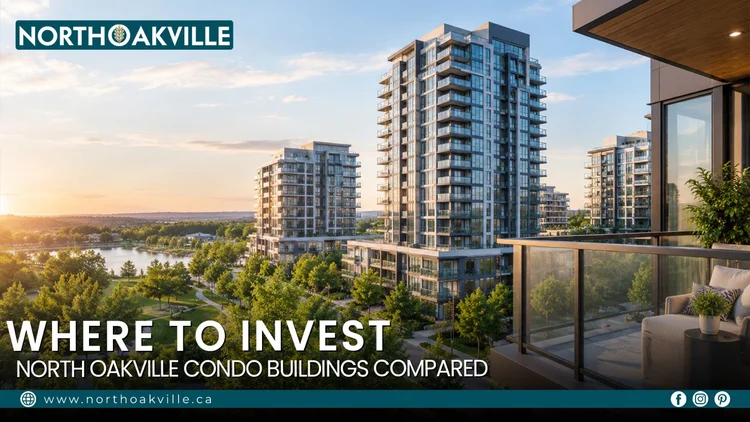
North Oakville offers a wide range of housing, from condo apartments and stacked townhomes to freehold townhouses and detached homes. The area is planned as a growing urban community with residential, commercial, employment, transit, parks and trail connections — the Town of Oakville's North Oakville Secondary Plans cover the area north of Dundas Street and south of Highway 407, between Ninth Line and Tremaine Road, and are designed to accommodate significant population and employment growth while incorporating transit, walkability, parks and protected natural areas.
For a first-time buyer, that growth creates opportunity — but it also makes careful research especially important.
What Makes North Oakville Different for First-Time Buyers?
North Oakville is not one uniform neighbourhood. Different pockets offer very different housing choices, commuting patterns and levels of convenience — we cover this in more depth in our guide to the best neighbourhoods to buy property in North Oakville. If you're just starting to browse homes for sale in North Oakville, understanding these differences before you start scrolling listings will save a lot of wasted viewings later.
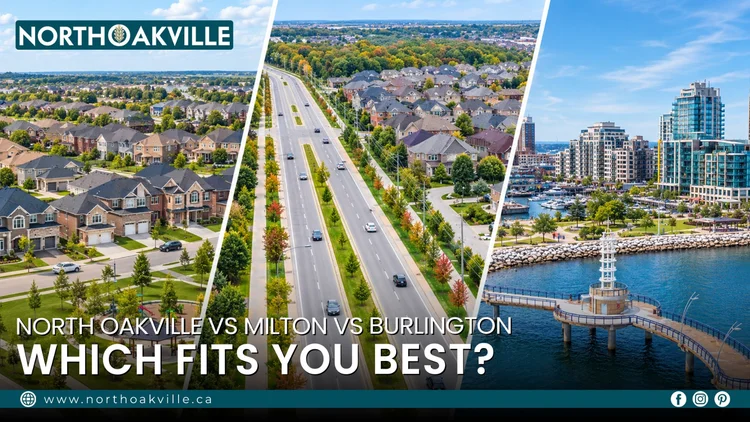
Uptown Core generally offers more condo and higher-density housing and is particularly attractive to buyers who value shops, services and transit. Glenorchy offers a mix of newer housing with access to Oakville Transit. Communities such as The Preserve lean toward more traditional suburban housing, including townhomes and detached homes — we compared these communities in detail in our best communities for young professionals guide, which is a useful companion read even for buyers outside that specific audience.
The area is also still developing. The Town's planning documents specifically anticipate higher-density and mixed-use development in parts of North Oakville, which means active development applications can be just as important as the home itself when deciding where to buy.
That's one of the most important lessons for anyone buying a home in one of Ontario's growing suburbs:
Don't only research the house. Research what can happen around the house.
Start With a Budget, Not a Listing
One of the most common first-time home buyer mistakes is starting with online listings and figuring out affordability afterward. A better approach is to establish a realistic monthly housing budget first.
The mortgage payment is only one part of the cost. A North Oakville buyer should also budget for:
Property taxes
Home insurance
Condo or common-element fees
Utilities
Mortgage default insurance, if applicable
Maintenance and repairs
Parking costs, where applicable
Moving expenses
Legal fees
Ontario Land Transfer Tax
Closing adjustments
Builder-related costs for a new home
Oakville's residential property tax rate is applied to the property's assessed value rather than its purchase price, so buyers shouldn't simply multiply the sale price by the tax rate to estimate their bill. For a full walkthrough of how this is calculated, see our North Oakville property tax guide.
A lender may approve a buyer for a certain mortgage amount, but that doesn't automatically mean the buyer should spend that much. A comfortable budget leaves room for the unexpected.
Understand the Down Payment Rules for a First Home in Ontario
For homes eligible for insured financing, the minimum down payment can start at 5%. Under current CMHC rules, a buyer generally needs 5% on the first $500,000 of the purchase price and 10% on the portion above $500,000, for homes priced below the applicable insured-financing threshold.
For example, a $750,000 property would require at least:
5% of the first $500,000 → $25,000
10% of the remaining $250,000 → $25,000
Minimum down payment: $50,000
A down payment below 20% generally means mortgage default insurance will be required, subject to the applicable rules and property qualification. These thresholds and percentages are set by federal mortgage insurance rules and can change, so buyers should always confirm the current figures with a mortgage professional before finalizing a budget.
For many North Oakville buyers, the minimum down payment isn't the only cash requirement — you'll also need enough for closing costs and a reserve after closing (more on that below).
First-Time Home Buyer Programs and Benefits in Ontario
Several first-time home buyer programs in Ontario and Canada can help with saving, financing, or reducing upfront costs. Eligibility should always be confirmed directly with the CRA or a tax professional before relying on any benefit, since program rules can be updated.
First Home Savings Account (FHSA)
The FHSA allows eligible buyers to contribute up to $8,000 per year, with a lifetime contribution limit of $40,000. Contributions can generally provide a tax deduction, while qualifying withdrawals used toward a first home are tax-free. For someone still saving toward a North Oakville property, the FHSA can be one of the most useful first-time home buyer benefits available.
Home Buyers' Plan (HBP)
The Home Buyers' Plan allows eligible buyers to withdraw up to $60,000 from an RRSP to purchase or build a qualifying home. The withdrawal generally has to be repaid over time under CRA rules. Temporary repayment relief currently applies to certain first withdrawals made between January 1, 2026 and December 31, 2028 — buyers planning an RRSP withdrawal should check the current CRA guidance for the exact repayment schedule that applies to them.
The HBP and FHSA can potentially be combined for the same qualifying home when the applicable conditions are met.
Home Buyers' Amount (HBTC)
The federal Home Buyers' Amount allows eligible buyers to claim up to $10,000 for a qualifying home purchase on their tax return. The actual tax benefit is a percentage of that amount, not a $10,000 cash rebate, so buyers shouldn't assume it works like a rebate cheque.
Ontario Land Transfer Tax Refund
Ontario provides a first-time homebuyer refund of up to $4,000 for eligible purchasers, applied against the province's Land Transfer Tax. Buyers whose Land Transfer Tax exceeds the refund amount still pay tax on the remainder — the refund reduces the bill, it doesn't eliminate it entirely for higher-priced homes. Closing costs for an Ontario home purchase should always include an estimate of Land Transfer Tax net of this refund; a real estate lawyer can calculate the exact amount owed and confirm eligibility.
New Home HST/GST Rebates Are Different From Resale
This distinction matters a lot in North Oakville because of how many new-build and pre-construction properties are on the market.
A resale home generally isn't subject to HST in the way a new-build transaction is. New homes can involve HST, but may also qualify for rebates that offset much of that cost.
The federal First-Time Home Buyers' GST/HST rebate currently provides eligible first-time buyers with relief on the federal GST or the federal portion of HST for qualifying new homes. For a qualifying new home valued at or below $1 million, the federal rebate can recover up to 100% of the GST or federal portion of HST, subject to a $50,000 maximum. The rebate gradually decreases for homes priced between $1 million and $1.5 million, and is unavailable at or above $1.5 million.
Separately, Ontario's First-Time Home Buyers' rebate can provide up to $80,000 toward the provincial portion of HST for eligible purchases, following the federal program's eligibility conditions. This is distinct from Ontario's general new housing rebate, which is a separate program with its own conditions — a tax professional can confirm which one actually applies to your purchase.
Because HST treatment depends on the specific property, purchase agreement, and buyer's circumstances, always have a lawyer or tax professional confirm exactly how a rebate applies before assuming a particular dollar amount.
Decide Which Type of Home Fits You
North Oakville gives first-time buyers several paths into the market.
Property Type | Main Advantage | Main Consideration |
|---|---|---|
Condo apartment | Lower entry price, less exterior maintenance | Monthly condo fees, less private space |
Stacked or condo townhouse | More space than most apartments | Condo/common-element fees |
Freehold townhouse | More privacy and control | Higher purchase price and maintenance |
Detached home | Maximum space and privacy | Higher purchase price, taxes and maintenance |
New move-in-ready home | Brand-new property without a multi-year wait | New-home premium, builder-related costs |
Pre-construction | Staged deposit schedule, customization options | Construction, financing and timing risk |
There's no universally "best" option here. A first-time buyer who works remotely and wants a yard will value a townhouse very differently than a single professional who prefers a low-maintenance condo close to services. For a deeper side-by-side, see our condo vs. detached comparison for North Oakville.
Resale vs New Construction vs Pre-Construction
This decision deserves serious attention, since it changes almost everything about the buying process.
Resale Homes
A resale property gives the buyer something extremely valuable: visibility. You can see the actual home, inspect its condition, examine the surrounding streets, and often review the property's history. A conditional offer may allow time for financing, inspection, and other due diligence, depending on the agreement.
For a condo resale specifically, the buyer can request a status certificate containing important information about the unit and the condominium corporation. In Ontario, a condominium corporation must provide the status certificate within 10 days of receiving the request and payment, and the maximum fee is $100 including taxes and materials.
Newly Built, Move-In-Ready Homes
A completed new home offers much of the appeal of new construction without the multi-year wait tied to pre-construction. The buyer can see the finished property, complete the Pre-Delivery Inspection, and generally make a financing decision based on a near-term closing rather than a completion date years away.
New homes enrolled with Tarion carry statutory warranty protection, with coverage periods of one, two, and seven years for different categories of defects and obligations. A Pre-Delivery Inspection (PDI) is mandatory for new homes enrolled with Tarion.
Pre-Construction Homes
Pre-construction can appeal to buyers who don't need a home immediately and want more time to prepare for ownership. Deposits are typically staged according to a schedule in the purchase agreement rather than paid all at once, and buyers may have the opportunity to select finishes or upgrades depending on the project. For more detail on how this works locally, see our guide to buying a pre-construction home in North Oakville.
But pre-construction introduces risks that don't exist to the same extent with a completed resale property. A mortgage pre-approval made years before completion is not a guarantee of qualifying for the final mortgage — income, debt, credit profile, property value, and lending conditions can all change in the meantime. Construction timelines can shift too. Treat a pre-construction purchase as a long-term financial commitment, not simply a home reservation.
Choose Your North Oakville Community Carefully
Each of North Oakville's main communities suits a different kind of buyer, so it's worth understanding the basic personality of each one before you start booking showings.
Uptown Core
A strong option for buyers who prioritize convenience, services, and transit. The area has a mix of condos, townhomes and other higher-density housing, and benefits from the Uptown Core transit hub — Oakville Transit's Route 37 serves neighbourhoods east and west of Trafalgar Road north of Dundas Street and connects at the Uptown Core Terminal. For a first-time buyer who prefers condo living and easy access to everyday services, this is worth a close look.
Glenorchy
A newer suburban environment with a mix of housing types and access to Oakville Transit (also served by Route 37). Buyers should still weigh how much driving they expect to do, especially if their workplace is outside Oakville.
The Preserve
More strongly associated with family-oriented, low-rise housing, including townhomes and detached properties. Buyers considering this area should pay close attention to purchase price, property taxes, commute patterns, and future development around the specific street.
Joshua Creek and Joshua Meadows
These areas can appeal to buyers who place a high value on access to major roads and highways along with larger homes, though the higher price point can make them less accessible for a first-time buyer with limited savings.
The right question isn't which community is "better" — it's which community fits your budget and daily routine.
Rural and Emerging North Oakville
Some parts of North Oakville are still evolving. That can mean newer homes and future amenities, but it can also mean ongoing construction activity, changing road networks, and services that are still being built out. The Town's planning framework anticipates continued growth here, including residential, commercial, and employment uses, transit connections, and higher-density development in designated areas.
Never Assume an Empty Lot Will Stay Empty
This is one of the most important North Oakville-specific checks a buyer can make. Before buying, look beyond the immediate property — check the Town of Oakville's active development applications and planning information for nearby land. Zoning rules determine permitted uses, building heights, setbacks, parking, and other development characteristics.
A buyer who falls in love with a backyard view should know whether the land behind the property is:
Protected natural heritage
Parkland
Planned residential development
Commercial land
Employment land
A future road
Or simply vacant land awaiting development
North Oakville's planning framework is explicitly designed for continued urban growth, so this step should never be skipped.
Check the School Assignment, Not Just the School's Reputation
Families should verify the exact school assignment using the property's actual address rather than a listing description that says a home is "close to" a particular school. School boundaries can change as new schools open and enrolment shifts — the HDSB has had active boundary review processes affecting parts of Oakville, including Northwest Oakville.
The HDSB's Find My Local School tool lets families check the designated school for a specific address, and can also confirm transportation eligibility where applicable. For a broader look at the options, see our guide to the best high schools in North Oakville.
Always verify the address directly with the school board before assuming.
Understand Condo and POTL Fees
Some North Oakville homes that appear similar to traditional freehold properties may still involve common elements and associated fees, sometimes through a Parcel of Tied Land (POTL) structure. Buyers should determine exactly what they own outright and what they share with neighbours.
For condos, the status certificate reveals important information about the corporation, including financial details, reserve fund information, and legal matters — legal counsel should always review it before you waive a condition.
For any property with common elements, buyers should understand:
What areas are maintained collectively
Who is responsible for roads or private lanes
What the monthly fee covers
How fees are calculated
Whether reserve funds are healthy
Whether special assessments are possible
What maintenance responsibilities remain with the homeowner
A lower purchase price doesn't necessarily mean lower monthly housing costs once these fees are factored in.
Get a Mortgage Pre-Approval Before Serious House Hunting
A mortgage pre-approval helps establish a realistic price range and gives you a clearer picture of your borrowing capacity. It should not be treated as a guarantee that every future property will receive final financing.
This distinction matters most for pre-construction. With a resale or completed new home, the gap between purchase and closing is usually short. With pre-construction, buyers may be waiting years — during which employment, debt, interest rates, credit, and property valuation can all change before the final mortgage is arranged.
Build the Right Team of Professionals
A first-time buyer doesn't need to handle the transaction alone. The team typically includes:
Real estate agent
Mortgage professional
Real estate lawyer
Home inspector
Insurance provider
Tax professional, where needed
Each one handles a different part of the transaction. The lawyer, in particular, should review the Agreement of Purchase and Sale and any relevant condominium or builder documents before you become committed to terms you don't fully understand.
Do a Proper Home Inspection
For a resale home, a professional home inspection can identify issues that are difficult for an inexperienced buyer to spot. Even in North Oakville's newer subdivisions, an inspection can still be worthwhile — a newer home is not automatically a problem-free home.
A typical inspection covers:
Roof
Foundation
Grading and drainage
Windows and doors
HVAC equipment
Plumbing
Electrical systems
Attic insulation and ventilation
Basement
Appliances
Visible moisture concerns
Understand the Pre-Delivery Inspection (PDI)
For a new home enrolled with Tarion, the Pre-Delivery Inspection is an important milestone — Tarion confirms the PDI is mandatory for enrolled new homes and is meant to document the home's condition before possession or occupancy.
Document visible deficiencies carefully rather than assuming the builder will remember every issue discussed during the walkthrough. The PDI isn't a ceremonial walk through the house — it creates an important record of the home's condition at that point in time.
Don't Forget Tarion After Moving In
New-home warranty responsibilities continue after possession. Tarion's warranty system provides different protection periods — including one-year, two-year, and seven-year coverage — for qualifying items. Buyers should understand the applicable reporting deadlines and use the Tarion MyHome system where required, rather than waiting until a problem becomes severe.
Review the Statement of Adjustments Carefully
Closing costs for an Ontario home purchase aren't limited to Land Transfer Tax and legal fees. The final statement of adjustments can include items such as:
Property tax adjustments
Utility adjustments
Condo fees
Common-element fees
HST-related amounts, where applicable to new construction
Builder adjustments
Other contractual charges
For new-construction purchases specifically, HST treatment depends on the Agreement of Purchase and Sale, rebate assignment, any builder credits, and the buyer's eligibility — it's rarely a simple line item, which is another reason to have a lawyer review it rather than estimating it yourself.
For a pre-construction purchase, have your lawyer compare the final statement against the original Agreement of Purchase and Sale and any negotiated caps or protections. Never assume a builder's estimate from years earlier matches the final amount due at closing.
Think About Insurance Before Closing
Mortgage lenders typically require proof of appropriate property insurance before advancing mortgage funds. For a detached or freehold property, coverage normally needs to address both the building and liability. Condo owners generally purchase their own contents and liability coverage, while the condominium corporation carries insurance for common elements and shared areas under its own policy. An insurance provider can explain exactly what's covered and what remains the owner's responsibility.
Common First-Time Buyer Mistakes
Spending the maximum amount the lender approves. Approval is based on lending criteria — comfortable ownership is a personal financial decision.
Forgetting closing costs. A buyer who puts every available dollar toward the down payment may struggle to cover legal fees, Land Transfer Tax, adjustments, moving expenses, and immediate repairs.
Assuming a new home has no maintenance. New construction reduces some immediate repair concerns, but maintenance doesn't disappear.
Treating pre-construction as guaranteed financing. A pre-approval made years before closing does not guarantee final mortgage approval.
Ignoring future development. An attractive view today may not stay that way — North Oakville's official planning documents and active development applications make this especially important to check.
Buying based only on school ratings. School boundaries and enrolment conditions can change — always verify the actual designated school through current board information.
Focusing only on purchase price. Two homes at similar prices can have very different monthly costs once taxes, condo fees, insurance, utilities, and maintenance are factored in.
A First-Time Home Buyer Checklist for North Oakville
Before making an offer:
Set a comfortable purchase budget
Get mortgage pre-approval
Calculate your available down payment
Reserve money for closing costs
Compare condo, townhouse, and detached options
Research the specific North Oakville community
Verify school boundaries
Review nearby development applications
Check transit and commuting options
Understand property taxes and monthly fees
Before firming up a resale purchase:
Complete the agreed home inspection
Confirm financing
Review the status certificate for a condo
Have your lawyer review title and relevant documents
Confirm inclusions and exclusions
Review adjustments
Arrange insurance
For new construction:
Review the builder agreement carefully
Understand the deposit schedule
Understand HST and applicable rebates
Review Tarion protection
Understand closing adjustments
Attend the PDI
Document deficiencies
Understand warranty reporting requirements
Before closing:
Confirm mortgage instructions
Confirm insurance
Review the final statement of adjustments
Confirm the amount required to close
Arrange utilities
Complete the final walkthrough, where applicable
Confirm closing logistics with your lawyer
Which North Oakville Home Is Best for a First-Time Buyer?
There's no single answer — it depends on who's buying.
For a single professional: A condo apartment or smaller townhouse often makes the most sense where convenience, lower maintenance, and transit access are priorities. Uptown Core is particularly worth exploring for its concentration of higher-density housing and transit connections.
For a young couple: A townhouse can offer a useful middle ground between condo living and detached-home ownership. A couple that doesn't need to move immediately might also consider pre-construction, provided they understand the long-term financing and construction risks involved.
For a buyer with limited savings: A condo or smaller townhouse may offer a more manageable entry point. A staged pre-construction deposit schedule can spread payments over time on some projects, but that shouldn't be confused with the total commitment being cheaper — it still needs to be affordable in full.
For a buyer who needs to move quickly: A resale property or completed new home is generally more practical than pre-construction, since you can see the actual property and work toward a much nearer closing date.
For a buyer willing to wait several years: Pre-construction can be worth considering if your finances are stable, you understand the agreement, and you're comfortable with uncertainty around completion timing and future financing.
Final Thoughts
Buying a first home in North Oakville is about much more than finding a property that looks good in photos. The best purchase starts with a realistic budget and continues with careful research into the property, the neighbourhood, the school assignment, transportation, taxes, fees, and future development.
Continued growth is one of North Oakville's defining characteristics. The Town's planning framework calls for new housing, employment, commercial areas, transit connections, trails, and open spaces, while active planning and development applications continue to shape individual parts of the community — for the bigger picture on what's coming, see our guide to new developments in North Oakville.
A condo in Uptown Core, a townhouse in Glenorchy, a family home in The Preserve, or a new property in an emerging part of North Oakville can all be the right choice for the right buyer. The goal isn't to buy the most expensive home a lender will approve — it's to find a home that fits your budget, lifestyle, timeline, and long-term plans, while leaving enough financial room to actually enjoy owning it.
FAQs
Is North Oakville a good place for first-time home buyers?
North Oakville offers a broad range of housing types and continues to develop as a major urban growth area within the broader North Oakville real estate market. The right choice depends on your budget, preferred property type, commute, and lifestyle.
How much down payment is needed for a first home in North Oakville?
For eligible homes using insured financing, the minimum can start at 5%. Current CMHC rules generally require 5% on the first $500,000 and 10% on the portion above that, up to the applicable insured-financing threshold — always confirm the current rules with a mortgage professional before budgeting.
What first-time home buyer programs are available in Ontario?
Common options include the First Home Savings Account (FHSA), the Home Buyers' Plan (HBP), the federal Home Buyers' Amount, and the Ontario Land Transfer Tax refund for first-time buyers. Eligibility and amounts should be confirmed with the CRA or a tax professional, since program details can change.
Can first-time buyers use an FHSA and RRSP for the same home?
Potentially, yes — eligible buyers can use qualifying FHSA withdrawals and the Home Buyers' Plan for the same home when all applicable conditions are met.
Do first-time buyers pay Ontario Land Transfer Tax?
Generally yes, where applicable, but eligible first-time buyers can receive an Ontario refund of up to $4,000 that reduces the amount owed.
What are typical closing costs for a home purchase in Ontario?
Beyond Land Transfer Tax, expect legal fees, title insurance, adjustments for property tax and utilities, and — for new construction — HST-related amounts and builder adjustments. A lawyer can provide an itemized estimate specific to your purchase before closing.
Is buying a condo easier than buying a detached home?
A condo can have a lower purchase price and less exterior maintenance, but buyers need to understand condo fees, rules, reserve funds, and the corporation's financial position. A detached home generally offers more control and private space but usually requires more maintenance and a larger overall budget.
Should a first-time buyer buy resale or new construction?
Resale offers greater visibility, since you can inspect the completed property and review its existing condition. New construction provides modern systems and statutory Tarion warranty protection, but can involve builder-specific terms and additional costs.
Is pre-construction a good choice for first-time buyers?
It can suit buyers with stable finances who don't need immediate occupancy and understand the risks tied to future financing, construction timing, and the purchase agreement. It isn't automatically less expensive than resale once the full commitment is considered.
Should buyers check future development in North Oakville?
Yes. North Oakville is a major growth area, and the Town maintains planning information and active development applications. Investigate nearby applications before committing to a property, especially if views, traffic, or future density matter to you.
How can a buyer confirm the correct school for a North Oakville home?
The HDSB's Find My Local School tool lets families check the designated school using the home's address. Boundaries can change, so verify current information rather than relying only on a listing description.
What is a status certificate?
A status certificate provides important information about a resale condominium unit and its corporation, including financial and legal details. It's strongly recommended that a buyer's legal counsel review it before conditions are waived.
What is a Pre-Delivery Inspection?
A Pre-Delivery Inspection (PDI) is a walkthrough of a new home before possession or occupancy. It's mandatory for new homes enrolled with Tarion and is used to formally document the home's condition before the buyer takes possession.